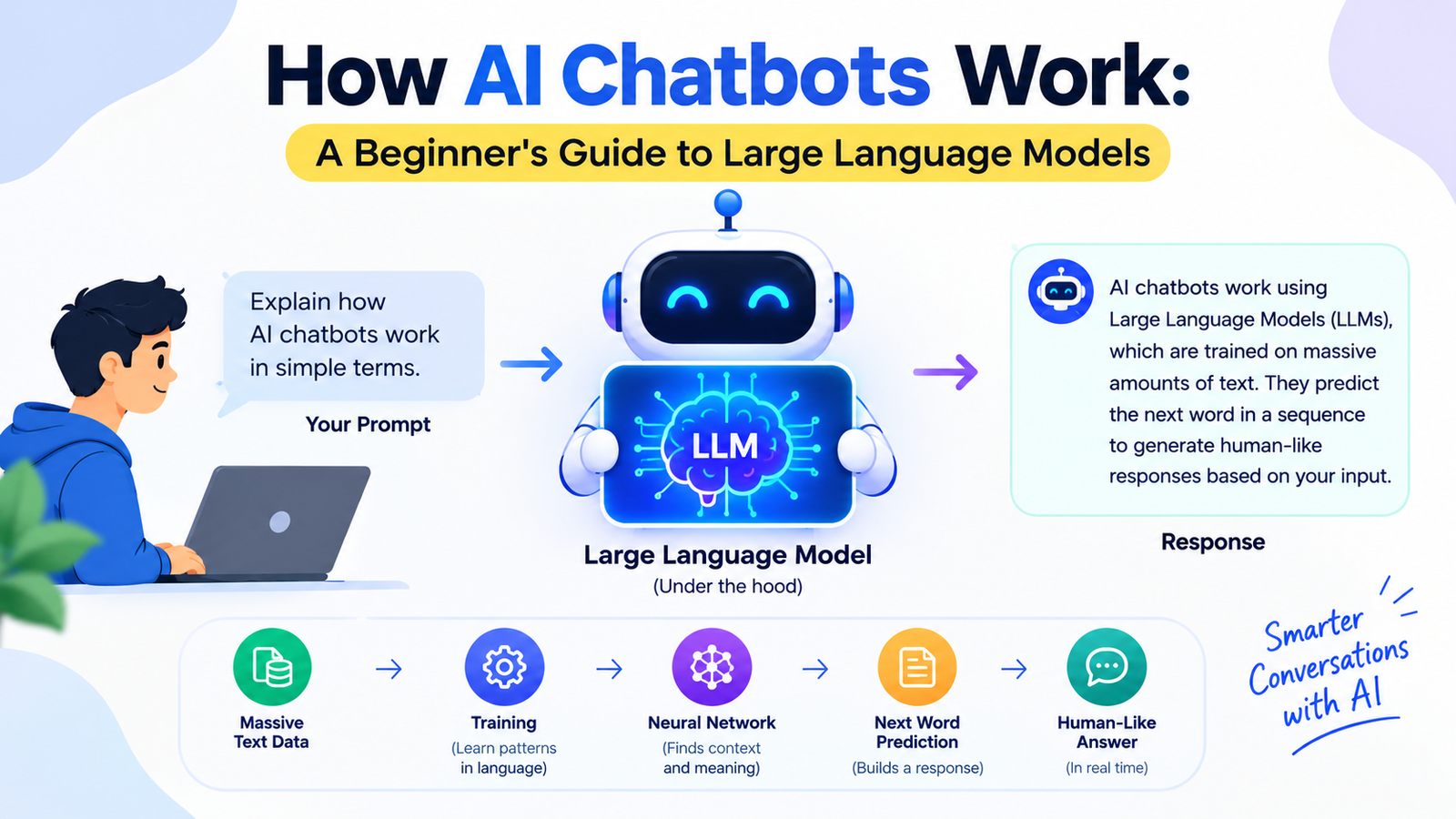
You type a question, and within seconds an AI chatbot writes a clear, human-sounding answer. It can explain physics, draft an email, or debug code. It feels like magic, but it is not. Behind the screen is a type of software called a large language model, or LLM, and the basic idea is simpler than most people expect.
This guide explains how these systems work in plain English, with no maths or coding required. By the end, you will understand what is happening when you chat with an AI, why it sometimes makes mistakes, and how to use it more wisely.
What Is a Large Language Model?
A large language model is a computer program trained on a huge amount of text, such as books, articles, websites and code. During training, it learns patterns in how language works: which words tend to follow which, how sentences are built, how explanations are structured, and how facts are usually described.
The word “large” refers to two things. First, the amount of training data is enormous. Second, the model itself has billions of adjustable numbers inside it, called parameters. These numbers are what the model “learns” during training. You can think of them as billions of tiny dials that were tuned until the model became good at predicting language.
The Core Idea: Predicting the Next Word
At its heart, a language model does one thing: it predicts what comes next in a piece of text.
If you read the sentence “The capital of France is…”, you instantly think “Paris”. A language model does the same, but it assigns a probability to every possible next word. “Paris” gets a very high probability, “Lyon” a small one, and “banana” almost zero. It picks a likely word, adds it to the sentence, and then repeats the process for the next word, and the next, until the answer is complete.
That is the entire loop. A long, thoughtful-looking answer is built one small piece at a time. The surprising thing is how much ability emerges from this simple goal when the model is large enough and trained on enough text.
What Are Tokens?
Models do not read words exactly as we do. They break text into small chunks called tokens. A token can be a whole word, part of a word, or even a punctuation mark. For example, a long word may be split into two or three tokens.
Tokens matter for two practical reasons:
- Length limits. Every model has a maximum number of tokens it can handle in one conversation, called its context window. If your chat gets too long, the model may lose track of earlier parts.
- Cost and speed. Many AI services charge or limit usage based on tokens.
How the Model Is Trained
Training happens in stages.
Stage 1: Pre-training. The model reads a vast collection of text and repeatedly tries to predict missing or next words. Each time it guesses wrong, its internal numbers are adjusted slightly. After billions of these small corrections, it becomes very good at language patterns. This stage needs enormous computing power and takes weeks or months.
Stage 2: Fine-tuning. A pre-trained model is a powerful text predictor, but it is not yet a helpful assistant. It might continue your question with another question instead of answering. In fine-tuning, the model is trained on examples of good conversations, so it learns to follow instructions and respond helpfully.
Stage 3: Feedback from humans. Many systems are further improved using human reviewers who compare different answers and mark which one is better. The model learns to prefer answers that are clearer, safer and more useful.
The Transformer: The Technology Inside
Most modern language models are built on an architecture called the transformer, introduced in 2017. Its key feature is something called attention.
Attention lets the model decide which words in a sentence matter most for understanding another word. In the sentence “The trophy did not fit in the suitcase because it was too big,” what does “it” refer to? A human knows it means the trophy. Attention helps the model connect “it” with “trophy” rather than “suitcase”. This ability to weigh relationships between words across a whole passage is a major reason modern chatbots understand context so well.
Why AI Chatbots Sometimes Get Things Wrong
Because a language model predicts likely text rather than looking up verified facts, it can produce answers that sound confident but are incorrect. This is often called a hallucination.
Common reasons include:
- No built-in fact checker. The model generates plausible text. Plausible is not the same as true.
- Gaps in training data. If a topic was rare in the training text, the model may guess.
- Outdated knowledge. The model only knows what was in its training data, up to a certain date, unless it is connected to a search tool.
- Ambiguous questions. Vague prompts lead to vague or wrong answers.
This is why you should verify important facts, such as medical, legal, financial or academic information, with reliable sources.
What AI Chatbots Are Good At
Understanding the mechanism also shows where these tools shine:
- Explaining concepts in simple language and at different difficulty levels.
- Drafting and editing text, such as emails, summaries, and outlines.
- Brainstorming ideas, names and approaches.
- Translating and rephrasing between languages and tones.
- Helping with code, such as explaining errors and suggesting fixes.
- Organising information, such as turning notes into a table or study plan.
What They Are Not Good At
- Guaranteed accuracy. They can be wrong, so treat them as a smart assistant, not an authority.
- Real-time facts, unless they use a search feature.
- No real understanding or feelings. They process patterns in text. They do not have personal experiences or emotions.
- Complex reasoning without care. Multi-step maths or logic can go wrong, so check the steps.
Tips for Getting Better Answers
The quality of your question strongly affects the answer.
- Be specific. Instead of “Explain photosynthesis”, try “Explain photosynthesis in 150 words for a Class 10 student, with one real-life example.”
- Give context. Say who the answer is for and what you plan to do with it.
- Ask for a format. Request bullet points, a table or step-by-step instructions.
- Iterate. If the first answer is off, say what to change instead of starting over.
- Ask for reasoning or sources, then check them yourself.
Is My Data Safe?
Different services handle data differently. As a rule, avoid typing passwords, bank details, Aadhaar or other personal identifiers into any chatbot. Read the privacy settings of the tool you use and check whether your conversations may be used to improve the model.
The Bigger Picture
Large language models are one of the most important technology shifts of this decade, but they are tools, not replacements for human thinking. The people who benefit most are those who understand both the power and the limits: they use AI to speed up learning and work, and they keep their own judgment switched on.
Frequently Asked Questions
Do AI chatbots think like humans? No. They recognise patterns in language and generate likely responses. The results can look like thinking, but the process is very different from human reasoning.
Does the AI search the internet for every answer? Not by default. Most answers come from patterns learned during training. Some tools add a search feature to bring in current information.
Why does the same question give different answers each time? There is some randomness in how the next word is chosen, which makes responses more natural and varied.
Can AI replace teachers or students’ own effort? It can explain and guide, but real learning still needs your effort. Using AI to understand ideas is helpful. Using it to skip thinking harms your growth.
Do I need to know coding to use AI? No. You only need to write clear instructions in everyday language.
Final Thoughts
An AI chatbot is, at its core, a very advanced next-word predictor trained on a vast amount of human writing. That one idea explains both its impressive skills and its occasional confident mistakes. Use it to learn faster, draft better, and explore ideas, but always check important facts and keep thinking for yourself.
What would you like to understand better about AI? Leave a comment, and we will cover it in a future post.
About the Author