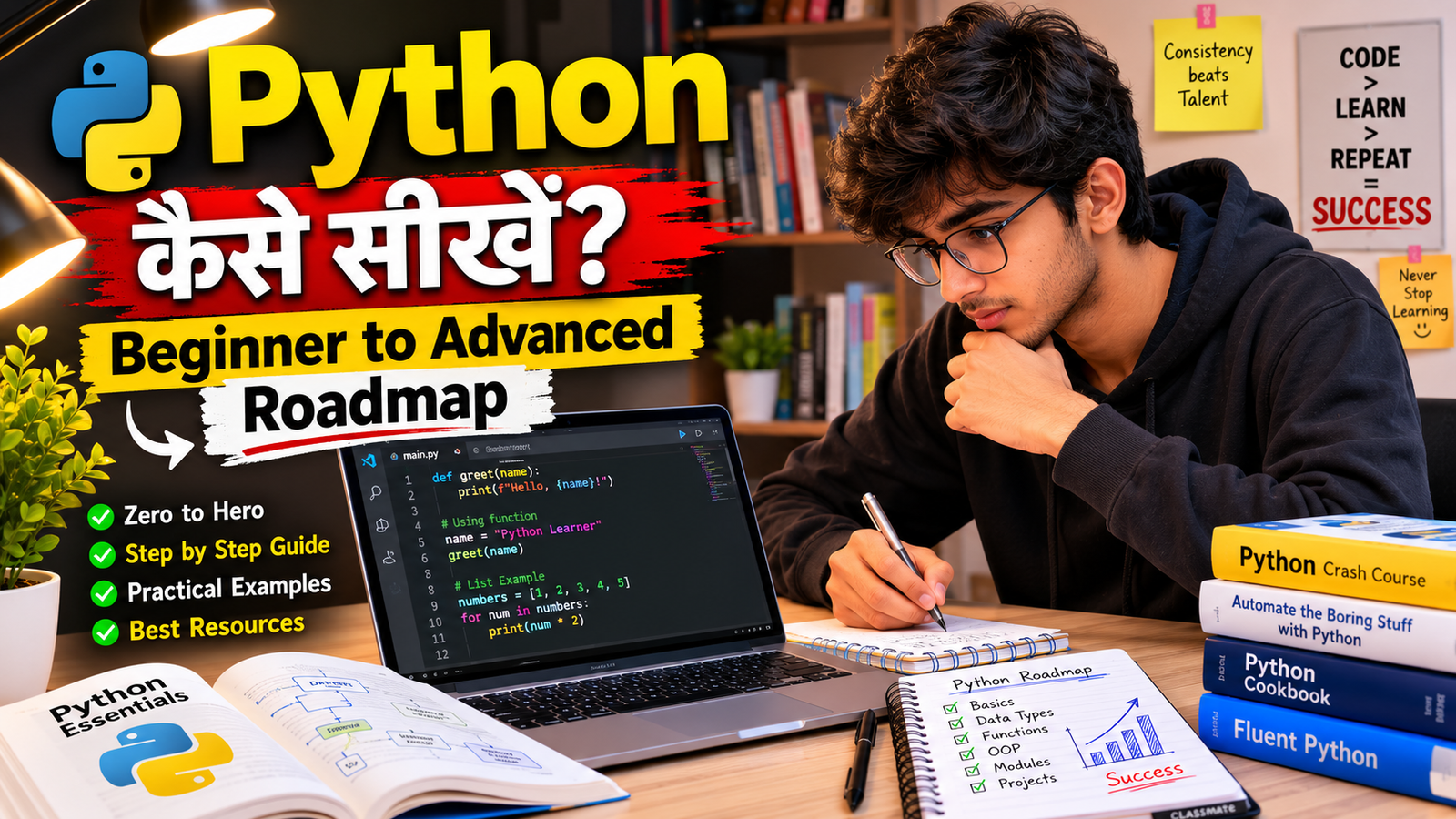
2026 में अगर आप एक programming language सीखना चाहते हैं जो versatile हो, job market में demand हो, और beginners के लिए भी easy हो — तो जवाब एक ही है: Python।
Python आज दुनिया की सबसे popular programming language है। Stack Overflow Developer Survey 2025 में Python लगातार तीसरे साल most loved और most wanted language रही। GitHub पर Python repositories की संख्या हर साल 20% से ज़्यादा बढ़ रही है।
लेकिन सबसे interesting बात यह है कि Python सिर्फ एक language नहीं है — यह एक gateway है। Python सीखने के बाद आप AI Engineer बन सकते हैं, Data Scientist बन सकते हैं, Web Developer बन सकते हैं, या Automation specialist बन सकते हैं।
India में Python developers की average salary ₹6-25 लाख सालाना है, और senior level पर यह ₹50 लाख से भी ज़्यादा हो सकती है।
लेकिन बहुत से लोग Python सीखना शुरू करते हैं और बीच में छोड़ देते हैं — क्योंकि कोई clear roadmap नहीं होता। इस article में हम वो roadmap देंगे जो actually काम करता है।
👉 यह भी पढ़ें: Coding सीखने के लिए Best Programming Language कौन-सी है?
Python क्या है और क्यों सीखें?
Python एक high-level, interpreted programming language है जिसे Guido van Rossum ने 1991 में create किया था। इसकी syntax इतनी clean और readable है कि यह almost English जैसी लगती है।
एक simple example देखें। दूसरी languages में “Hello World” print करने के लिए कई lines लगती हैं। Python में सिर्फ एक line काफी है:
python
print("Hello World")बस इतना। कोई semicolons नहीं, कोई curly braces नहीं, कोई complicated syntax नहीं।
Python क्यों सीखें — 7 Strong Reasons
पहला — Beginner Friendly: Python का syntax सबसे आसान है। अगर आपने पहले कभी coding नहीं की तो Python सबसे अच्छी शुरुआत है।
दूसरा — Versatility: Web development, AI/ML, Data Science, Automation, Game Development, Scripting — Python almost हर जगह use होती है।
तीसरा — Job Market में Demand: 2026 में Python jobs की demand हर दूसरी language से ज़्यादा है।
चौथा — AI का Language: ChatGPT, TensorFlow, PyTorch — सभी Python में हैं। AI field में जाना हो तो Python must है।
पाँचवाँ — Huge Community: कोई भी problem आए, Stack Overflow या GitHub पर solution मिल जाता है।
छठा — Free और Open Source: Python बिल्कुल free है। कोई license fee नहीं।
सातवाँ — Freelancing में Excellent: Upwork और Fiverr पर Python developers को बहुत काम मिलता है।
Python सीखने से पहले क्या जानना ज़रूरी है
बहुत से beginners directly coding में jump कर देते हैं। पहले कुछ basics समझना ज़रूरी है।
क्या कोई Prerequisites हैं?
नहीं। Python सीखने के लिए पहले से कोई programming knowledge नहीं चाहिए। एक Computer या Laptop, internet connection, और सीखने की इच्छा — बस यही काफी है।
Python का Setup कैसे करें?
Step 1: Python.org से Python download करें (latest version)।
Step 2: Code editor install करें। Beginners के लिए VS Code सबसे अच्छा है — यह free है और Python के लिए perfect।
Step 3: VS Code में Python extension install करें।
बस — आप ready हैं coding शुरू करने के लिए।
Alternative — Online Python Editors
अगर setup नहीं करना तो:
- Google Colab — Free, browser में directly run होता है
- Replit — Online IDE, beginners के लिए excellent
- Kaggle Notebooks — Data Science के लिए
Python Beginner to Advanced Roadmap
यह roadmap तीन phases में divide है। हर phase में क्या सीखना है, कितना समय लगेगा, और कौन से resources use करने हैं — सब clearly बताया गया है।
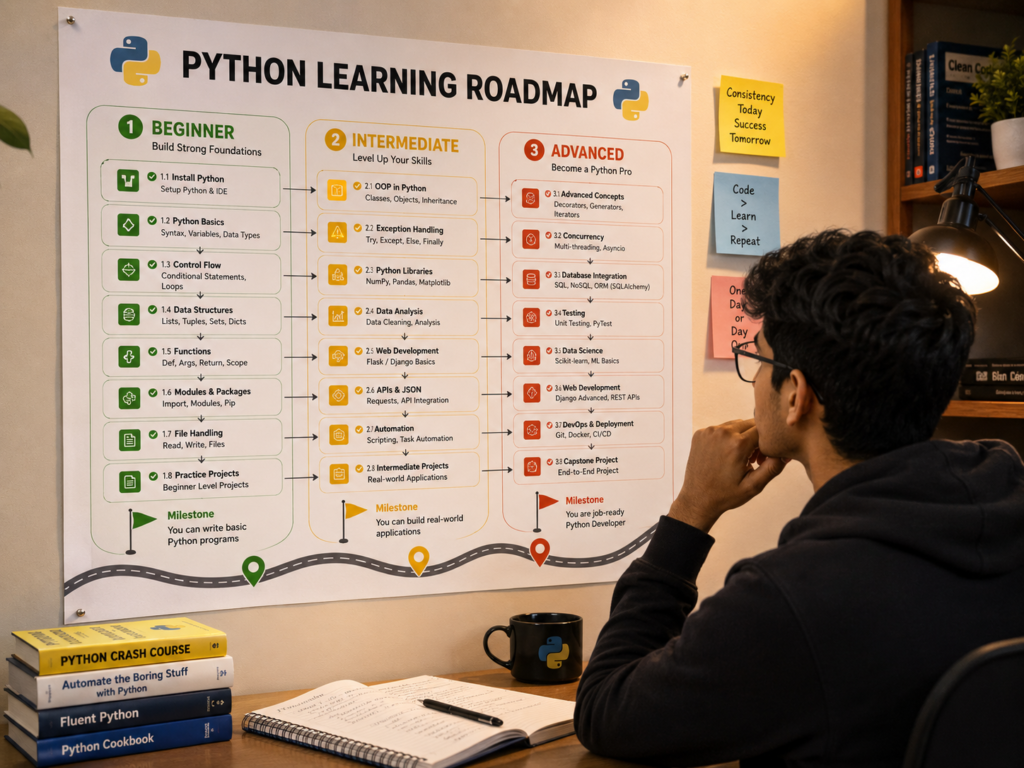
Phase 1 — Python Basics (Beginner Level) — 4-6 हफ्ते
यह phase सबसे important है। इसे slowly और carefully पूरा करें। जल्दबाजी बिल्कुल मत करें।
Week 1-2 — Absolute Basics
Variables और Data Types:
Python में variables declare करने का तरीका बहुत simple है:
python
name = "Karan"
age = 21
height = 5.9
is_student = True
Integers, floats, strings, booleans — इन सब को अच्छे से समझें।
Input और Output:
User से input लेना और output display करना।
String Operations:
Strings को join करना, slice करना, और format करना।
Basic Operators:
Arithmetic, Comparison, और Logical operators।
Week 3 — Control Flow
If-Else Statements:
Program को conditions के basis पर different directions में ले जाना।
For Loops और While Loops:
Repetitive tasks को automate करना।
Nested Loops:
Loop के अंदर loop।
Week 4 — Functions
Functions Python का एक core concept है। Code को reusable blocks में organize करना।
Parameters, return values, default arguments, और *args/**kwargs — यह सब इस week में cover करें।
Week 5-6 — Data Structures
यह Python का सबसे important part है।
Lists: Ordered, mutable collection
Tuples: Ordered, immutable collection
Dictionaries: Key-value pairs
Sets: Unique elements का collection
इन चारों को deeply समझें और practice करें। Python programming में इनका use हर जगह होता है।
Phase 1 के बाद आप क्या बना सकते हैं:
- Simple Calculator
- Number Guessing Game
- Basic To-Do List
- Temperature Converter
Phase 2 — Intermediate Python — 6-8 हफ्ते
Phase 1 complete होने के बाद Phase 2 शुरू करें। यह phase Python की असली power दिखाती है।
Week 7-8 — Object Oriented Programming (OOP)
OOP Python programming का एक fundamental concept है। इसे समझे बिना professional developer नहीं बन सकते।
Classes और Objects:
Real-world entities को code में represent करना।
4 Pillars of OOP:
- Encapsulation: Data को protect करना
- Inheritance: Parent class से properties inherit करना
- Polymorphism: Same method का different behavior
- Abstraction: Complex details hide करना
OOP को पहले conceptually समझें, फिर code में implement करें।
Week 9 — File Handling और Exception Handling
File Handling:
Files पढ़ना, लिखना, और delete करना। CSV files को handle करना।
Exception Handling:
Try-Except blocks से errors को gracefully handle करना। यह skill professional code के लिए बहुत important है।
Week 10 — Modules और Libraries
Python की असली power इसकी libraries में है।
Built-in Modules:
os— Operating system operationssys— System-specific parametersdatetime— Date और time operationsrandom— Random number generationmath— Mathematical functions
pip से Libraries Install करना:
pip install library-nameWeek 11-12 — Advanced Python Concepts
Comprehensions:
List, Dict, और Set comprehensions से concise code लिखना।
Lambda Functions:
Anonymous functions जो एक line में लिखी जाती हैं।
Decorators:
Functions को modify करने का powerful way।
Generators:
Memory-efficient iteration।
Regular Expressions:
Text patterns search और replace करना।
Phase 2 के बाद आप क्या बना सकते हैं:
- Contact Book Application
- Web Scraper
- File Organizer
- Simple API client
👉 यह भी पढ़ें: AI Engineer कैसे बनें? Complete Career Guide
Phase 3 — Advanced Python और Specialization — 3-6 महीने
Phase 3 वो है जहाँ आप एक specific domain choose करते हैं और उसमें deep dive करते हैं। यहाँ से आपका actual career path decide होता है।
Track 1 — Web Development
Framework: Django या Flask
Django — Full-featured web framework। Instagram, Pinterest जैसी sites Django पर बनी हैं।
Flask — Lightweight framework। Microservices और APIs के लिए perfect।
क्या सीखें:
- REST API बनाना
- Database integration (PostgreSQL, SQLite)
- Authentication और Authorization
- Deployment (Heroku, AWS, Render)
Projects:
- Blog Website
- E-commerce Backend
- Social Media API
Track 2 — Data Science और AI/ML
यह 2026 में सबसे popular और highest-paying track है।
Libraries जो सीखनी हैं:
NumPy: Numerical computing के लिए। Arrays और mathematical operations।
Pandas: Data manipulation के लिए। DataFrames में data clean और analyze करना।
Matplotlib और Seaborn: Data visualization के लिए। Beautiful charts और graphs।
Scikit-learn: Machine Learning के लिए। Regression, Classification, Clustering algorithms।
TensorFlow या PyTorch: Deep Learning के लिए।
Projects:
- House Price Prediction
- Customer Churn Analysis
- Image Classification
- Sentiment Analysis
👉 यह भी पढ़ें: Coding सीखने के लिए Best Programming Language कौन-सी है?
Track 3 — Automation और Scripting
Python automation के लिए सबसे powerful language है।
Libraries:
- Selenium: Web browser automation
- PyAutoGUI: Desktop automation
- Schedule: Task scheduling
- Requests: HTTP requests
- BeautifulSoup: Web scraping
Projects:
- Instagram Auto-poster
- Excel data processor
- Automated report generator
- Price tracker website
Track 4 — Cybersecurity
Python cybersecurity में बहुत use होती है।
Libraries:
- Scapy: Network packet manipulation
- Nmap: Network scanning
- Paramiko: SSH connections
- Cryptography: Encryption/Decryption
Python सीखने के Best Resources 2026
| Resource | Type | Level | Cost |
|---|---|---|---|
| Python.org Official Tutorial | Documentation | Beginner | Free |
| CS50P — Harvard Python Course | Video + Projects | Beginner | Free |
| Automate the Boring Stuff with Python | Book + Website | Beginner-Intermediate | Free |
| Python Crash Course (Book) | Book | Beginner | ₹500-800 |
| Real Python (realpython.com) | Articles + Videos | All Levels | Free + Paid |
| Kaggle Python Course | Hands-on | Beginner | Free |
| Python Bootcamp — Udemy | Video Course | All Levels | ₹500-1500 |
| CodeWithHarry (YouTube) | Hindi Videos | Beginner | Free |
| Apna College (YouTube) | Hindi Videos | Beginner | Free |
| Fast.ai | Practical ML | Advanced | Free |
- Python Official Documentation
- CS50P — Harvard Free Python Course
- Automate the Boring Stuff with Python
- Real Python
- Kaggle Python Course
Python Salary और Career Scope
India में Python Developer Salary
| Role | Experience | Annual Salary |
|---|---|---|
| Python Developer (Fresher) | 0-1 साल | ₹4-8 लाख |
| Python Developer (Junior) | 1-3 साल | ₹8-15 लाख |
| Data Scientist (Python) | 2-4 साल | ₹12-25 लाख |
| ML Engineer (Python) | 3-5 साल | ₹18-35 लाख |
| Senior Python Developer | 5-8 साल | ₹25-50 लाख |
| Python Architect/Lead | 8+ साल | ₹50 लाख-₹1.5 करोड़ |
Abroad में Python Developer Salary:
- USA: $90,000 – $170,000 per year
- UK: £55,000 – £120,000 per year
- Canada: CAD 75,000 – CAD 140,000 per year
- Germany: €60,000 – €120,000 per year
- Australia: AUD 85,000 – AUD 145,000 per year
Top Companies Hiring Python Developers in India:
Google India, Microsoft India, Amazon, Flipkart, Swiggy, Zomato, Ola, PayTM, CRED, Razorpay, Mu Sigma, Fractal Analytics, TCS AI Division
Python Projects जो Portfolio बनाएंगे
Portfolio बनाना Python job पाने के लिए सबसे जरूरी है। यहाँ level-wise projects हैं।
Beginner Projects
- Calculator App: Basic arithmetic operations
- Password Generator: Random secure passwords
- Number Guessing Game: User vs computer
- Simple Quiz App: Multiple choice questions
- Mad Libs Generator: Story with user inputs
Intermediate Projects
- Weather App: API से real-time weather data
- Web Scraper: News headlines, prices scrape करना
- Expense Tracker: CSV file में data store करना
- URL Shortener: Links को shorten करना
- Email Sender: Automated emails
Advanced Projects
- Stock Price Predictor: ML से share prices predict करना
- Chatbot: NLP से conversational bot
- Image Classifier: Deep Learning से image categorize करना
- Sentiment Analyzer: Reviews को positive/negative classify करना
- Django Blog Website: Full-featured blog with authentication
Common Mistakes जो Python Beginners करते हैं
गलती 1 — Tutorial Hell में फँसना
सबसे common mistake। Beginners videos देखते रहते हैं, courses करते रहते हैं लेकिन खुद से code नहीं लिखते। इसे “Tutorial Hell” कहते हैं।
Solution: हर tutorial के साथ code साथ-साथ लिखें। Video pause करें और खुद implement करें।
गलती 2 — Multiple Courses एक साथ
“यह course करूँ या वो?” की confusion में लोग 3-4 courses एक साथ start करते हैं और कोई complete नहीं होता।
Solution: एक course चुनें, उसे पूरा करें, फिर दूसरा।
गलती 3 — Error आने पर हार मान लेना
Python में error आना 100% normal है — experienced developers को भी रोज़ errors आती हैं। Error message को ध्यान से पढ़ें, Google करें, और solve करें।
गलती 4 — Theory ज़्यादा, Practice कम
Python पढ़ने से नहीं, लिखने से आती है। हर concept सीखने के बाद उसे code में implement करें।
गलती 5 — Version Confusion
Python 2 और Python 3 अलग हैं। हमेशा Python 3 use करें। Python 2 officially discontinued है।
गलती 6 — Copy-Paste Coding
Stack Overflow या AI से code copy करके काम चला लेते हैं बिना समझे। Short-term में help करता है लेकिन long-term में बहुत नुकसान।
गलती 7 — Portfolio नहीं बनाना
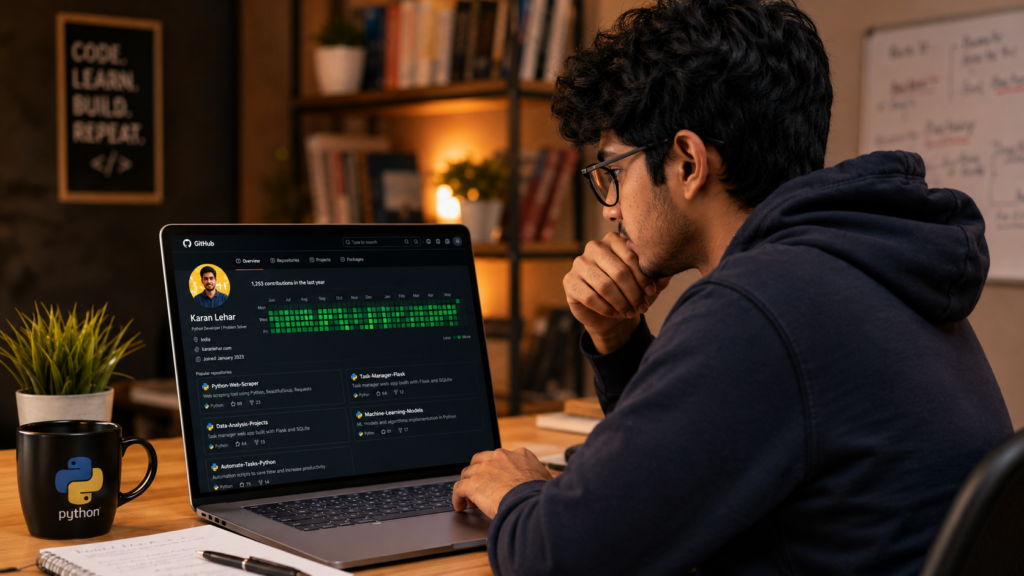
Python सीख ली, projects नहीं बनाए। बिना GitHub portfolio के job interview में बहुत मुश्किल होती है।
Python सीखने का Daily Study Plan
एक realistic daily plan जो actually work करता है।
अगर आपके पास 1-2 घंटे हैं (Working Professionals/Students):
सोमवार से शुक्रवार: 1 घंटे नया concept सीखें + 30 minutes practice।
शनिवार-रविवार: 2-3 घंटे project work।
अगर आपके पास 4-5 घंटे हैं (Full-time learners):
पहले 2 घंटे: नया concept और tutorial।
अगले 2 घंटे: Coding practice और problems solve करना।
30 minutes: एक problem Hackerrank या LeetCode पर।
Key Rule: रोज़ कम से कम एक line of code लिखें। Momentum maintain करना सबसे जरूरी है।
Python Interview Preparation
Job के लिए Python interview में यह topics most important हैं।
Technical Topics:
- Data Structures (List, Dict, Set, Tuple) के operations
- OOP concepts और implementation
- File handling
- Exception handling
- Python built-in functions
- List comprehensions
- Lambda, Map, Filter, Reduce
- Generators और Iterators
- Decorators
Coding Challenges:
LeetCode पर Python में problems solve करें। Easy level से शुरू करें।
Practice Platforms:
- LeetCode (Technical interviews के लिए)
- HackerRank (Beginner friendly)
- CodeChef (Competitive programming)
- Exercism.io (Guided exercises)
👉 यह भी पढ़ें: Machine Learning क्या है? आसान भाषा में पूरी जानकारी
FAQs
Q1. Python सीखने में कितना समय लगता है?
Basics (Phase 1) 4-6 हफ्तों में complete हो सकते हैं अगर daily 2 घंटे दें। Intermediate level पर आने में 3-4 महीने। Job-ready होने में 6-12 महीने। यह आपकी background, daily study time, और consistency पर depend करता है।
Q2. क्या Python बिना Math के सीख सकते हैं?
General Python (Web Development, Automation) के लिए बहुत कम Math चाहिए। लेकिन Data Science और ML के लिए Statistics, Linear Algebra, और Calculus की basic understanding ज़रूरी है।
Q3. Python 2 सीखें या Python 3?
हमेशा Python 3। Python 2 officially 2020 में discontinued हो गया। कोई भी नया project Python 3 में ही होता है।
Q4. क्या Python से Mobile Apps बना सकते हैं?
Directly नहीं। Android के लिए Kotlin/Java, iOS के लिए Swift best हैं। लेकिन Kivy framework से Python में cross-platform mobile apps बनाई जा सकती हैं, हालांकि यह mainstream नहीं है।
Q5. Python और JavaScript में से पहले कौन सा सीखें?
अगर AI/ML या Data Science में जाना है तो Python पहले। अगर Web Development में जाना है तो JavaScript पहले। अगर undecided हैं तो Python बेहतर है क्योंकि यह ज़्यादा versatile है।
Q6. क्या Python freelancing के लिए अच्छा है?
हाँ, बहुत अच्छा। Upwork और Fiverr पर Python automation, web scraping, और data analysis projects के लिए बहुत demand है। एक experienced Python freelancer ₹50,000-₹2,00,000 प्रति माह कमा सकता है।
Q7. Python सीखने के लिए कौन सा laptop चाहिए?
कोई भी laptop जिसमें 8GB RAM और i5 या equivalent processor हो काफी है। Mac, Windows, या Linux — Python सब पर perfectly run होती है। ML/Deep Learning के लिए GPU वाला laptop helpful होता है लेकिन शुरुआत में ज़रूरी नहीं।
Q8. क्या हिंदी में Python सीख सकते हैं?
बिल्कुल। CodeWithHarry और Apna College जैसे YouTube channels Hindi में बहुत अच्छे Python tutorials provide करते हैं और बिल्कुल free हैं।
Conclusion
Python 2026 में सीखने के लिए सबसे smart choice है। Easy to learn, versatile, high-paying, और future-proof — यह सब qualities एक ही language में हैं।
इस article में दिया गया roadmap follow करें:
- Phase 1 (4-6 हफ्ते): Basics — Variables, Loops, Functions, Data Structures
- Phase 2 (6-8 हफ्ते): OOP, File Handling, Libraries
- Phase 3 (3-6 महीने): Web Dev, Data Science, Automation में से एक track
सबसे important बात — आज ही शुरू करें। Python install करें, VS Code setup करें, और पहला print("Hello World") लिखें।
यह छोटा सा पहला कदम आपकी पूरी Python journey की शुरुआत होगी।
👉 यह भी पढ़ें: Data Scientist कैसे बनें? Complete Career Guide 2026
About the Author

2 thoughts on “Python कैसे सीखें? Beginner to Advanced Roadmap (2026)”